A Review of HNMUN: The University-Level Harvard Model United Nations Conference
HNMUN is the university-level Harvard conference, routinely confused with HMUN. The distinction in delegate age, application, and committee depth explained.
A Review of HNMUN: the University-Level Harvard Model United Nations Conference
Almost everyone who searches for "HNMUN Harvard National MUN review" is looking for HMUN, the high-school event. The mistake is common and costly. HNMUN is the university-level Harvard Model United Nations gathering run by the Harvard International Relations Council. HMUN is the secondary-school event run by the same organisation. They share a family of procedure, a host city, and a host institution. They serve completely different participants. A high school student who applies to HNMUN has wasted their registration fee. This is the distinction that matters.
Who Goes Where
HNMUN takes place in Boston every February. It runs four days, Thursday to Sunday. The participant pool is exclusively undergraduate and postgraduate students. There is no individual registration; admission is by delegation only, and the application process is competitive. HMUN draws participants aged roughly fourteen to eighteen, follows a separate application timeline, and attracts a different set of schools. If you are a high school student, a club officer, or a parent evaluating options, you want HMUN. If you are a university student, a gap-year applicant, or a faculty advisor for a collegiate delegation, HNMUN is the one.
HNMUN vs HMUN Difference: the Single Deciding Factor
The difference is the age of the participant pool. That single fact determines everything else: the pace of debate, the size of committees, the depth of the study guides, the award expectations, and the application process. HNMUN participants are university students who have often done MUN for years. They arrive knowing Harvard procedure, moderated caucus, unmoderated caucus, and the motion sequence. They expect a committee room where procedural complexity is higher and the pace is faster than at any school-level event.
Committee Size and Visibility
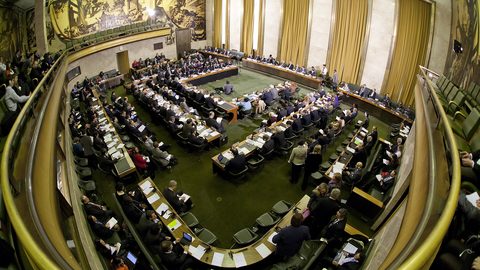
HNMUN committee sizes range from 15 to 400 participants depending on the type. A General Assembly committee can hold 200 or more. A crisis committee may hold 20 to 40. At HMUN, the largest GA committees are smaller, and crisis committees are tighter still. In a 200-person committee, speaking time is scarce. Visibility is hard. The participants who dominate are the ones who build blocs and steer the room during unmoderated caucus, not the ones who give polished speeches. If you thrive on formal debate and set speaking times, a 200-person GA may frustrate you. If you are comfortable working a room during unmoderated caucus, book it.
Procedural Expectations
Both events use Harvard-style parliamentary procedure, sometimes called modified UNA-USA procedure. That means moderated caucus, unmoderated caucus, and formal speakers' lists as the three modes of debate. Participants motion between them. Draft resolutions are authored by blocs and introduced as documents. The procedural rules are the same family. But at HNMUN, the dais expects you to handle procedural motions with confidence. A chair is unlikely to explain the difference between a Point of Order and a Point of Inquiry. At HMUN, the same chair might spend the first session walking newcomers through the rules. The HNMUN dais assumes prior experience. The committee runs accordingly.
.jpg)
University MUN Conference Harvard: Who This Conference Serves
HNMUN is one of the largest university-level MUN gatherings in the world. The organisers estimate total attendance between 3,000 and 4,000, spread across 30 to 40 committees. That puts it in the same tier as NMUN, which is also university-level but uses a different procedural family. HNMUN is the university-level flagship of the Harvard procedure circuit.
Who Should Attend
This event suits the experienced university participant who has done at least one prior MUN and understands how blocs form, how draft resolutions get written under time pressure, and how awards are decided. It suits the university club officer who needs to choose an event for a delegation budget and wants a competitive environment where their strongest members face real opposition. And it suits the gap-year applicant or recent graduate looking for a chairing role: HNMUN recruits its dais from experienced university participants and former attendees. If you want to staff an event, the HNMUN dais application is a separate track from HMUN, and the expectations are higher.
Who Should Skip
First-timers should skip HNMUN. Someone who has never done MUN will be lost in a 200-person committee where the dais does not slow down for procedural explanations. They will spend most of the first day trying to understand how to motion for a moderated caucus instead of building a bloc. That is not a failure of the participant. It is a mismatch. Start with a smaller university-level event or a strong school-level one like HMUN or NAIMUN. Come to HNMUN when you know what a bloc is and how to lead one.
Readers looking for analysis of actual UN peacekeeping operations, Security Council reform, or international law should go to academic international relations sources. Readers wanting current geopolitical news should go to a news organisation. Readers seeking a debate club where one side wins on the merits of an argument should look at competitive debate formats like World Schools or British Parliamentary; MUN rewards consensus-building, not clash. This guide covers the event itself, not the subject matter of its committees.
| Attribute | HNMUN Value |
|---|---|
| Organising body | Harvard International Relations Council (IRC) |
| Level | University (undergraduate and postgraduate) |
| Location | Boston, Massachusetts, USA |
| Typical month | February |
| Duration | 4 days (Thursday to Sunday) |
| Delegate age range | Undergraduate and postgraduate university students |
| Admission model | Delegation only (no individual delegates) |
| Minimum delegation size | 1 delegate (verify with current application) |
| Maximum delegation size | No published upper limit |
| Application type | Competitive delegation application |
| Application deadline | Typically October of preceding year |
| Selection criteria | Delegation experience, country preferences, application quality |
| Rules of procedure | Harvard-style (modified UNA-USA) |
| Crisis committees offered | Yes (single-crisis and joint crisis cabinets) |
| General Assembly committees offered | Yes |
| Economic and Social Council committees offered | Yes |
| Specialised agencies offered | Yes |
| Working language | English |
| Committee size range | 15 to 400 delegates |
| Position papers required | Yes, for most committees |
| Position paper deadline | Typically 2 to 3 weeks before conference |
| Awards offered | Best Delegate, Outstanding Delegate, Honourable Mention, Verbal Commendation |
| Awards criteria | Committee performance, position paper quality, diplomatic engagement |
| Typical total delegate count | 3,000 to 4,000 (estimated, verify with current year) |
| Typical number of committees | 30 to 40 |
| Conference year for values shown | 2025 |
HNMUN Application Process: What You Need to Know
The HNMUN application is a competitive delegation process, not a first-come, first-served registration. Delegations apply as a group from their institution. The application opens in the spring or summer before the February dates, with a deadline around October of the preceding year. The selection committee evaluates delegation experience, country preferences, and the quality of the application itself. A university that sends a strong application explaining why its members are prepared for a competitive university-level event has a much better chance of receiving first-choice country assignments than a delegation that submits a generic form.
No Individual Registration
You cannot apply alone. If you are a university student who wants to attend, you must join a delegation from your institution. If your institution does not have a MUN club, you have three options: start one, find a nearby university that accepts external participants, or look at NMUN. NMUN offers a different model that may accommodate individual registration through the National Collegiate Conference Association. The delegation-only model at HNMUN changes the social dynamics of the committee floor. Every person in the room represents a school, and blocs often form along school lines. Someone attending alone without a school affiliation will not be admitted.
Position Papers: Non-Negotiable
Most HNMUN committees require a position paper, due two to three weeks before the event. The position paper follows the standard format: topic background, past international action, country policy, and proposed solutions. The dais reads and scores these papers. They are not checked merely for completion. At an event with 3,000 to 4,000 attendees, the dais receives many papers, but HNMUN maintains a reputation for reading them seriously. A strong position paper improves your award eligibility. A missing or late position paper can disqualify you from awards entirely. Treat the deadline as non-negotiable.
Full specification
| Individual delegates or school delegations | University delegations and individuals | manufacturer |
|---|---|---|
| Run by | Harvard University | manufacturer |
| Where | Boston, United States | manufacturer |
| Working language | English | manufacturer |
| Who it is for | University | manufacturer |
| Rules of procedure | Harvard-style parliamentary procedure | manufacturer |
Figures labelled manufacturer are the maker's own claim and are measured by them. Owner reported figures are aggregated from owners and are the ones worth planning around.
Common Questions
What is the difference between HNMUN and HMUN?
HNMUN is the university-level Harvard Model United Nations conference. HMUN is the secondary-school-level conference. They are run by the same Harvard International Relations Council but have separate application processes, separate delegate pools, and separate organising teams. High school delegates should apply to HMUN; university delegates should apply to HNMUN.
Can a high school student attend HNMUN?
No. HNMUN is for undergraduate and postgraduate university students. A high school student who applies will be rejected, and the registration fee will not be refunded. If you are a high school student looking for a Harvard-run conference, apply to HMUN, which is held in Boston and runs in January.
How many delegates attend HNMUN?
The organisers estimate 3,000 to 4,000 delegates. This figure is not independently verified and changes annually. The official HNMUN website publishes the current year's numbers closer to the conference date.
What is Harvard procedure at the university level?
Harvard procedure uses three modes of debate: moderated caucus, unmoderated caucus, and the formal speakers' list. Delegates motion between these modes. Draft resolutions are written by blocs during unmoderated caucus and introduced as documents. At the university level, the pace is faster, the procedural rules are applied strictly, and the dais expects delegates to know the rules before arriving.
Does HNMUN have crisis committees?
Yes. HNMUN offers single-crisis committees and joint crisis cabinets. These committees use directives instead of resolutions as their primary output, and they respond to real-time fictional updates from the crisis staff. Crisis committees at HNMUN are known for being fast-paced and competitive.
How are awards decided at HNMUN?
The published criteria are committee performance, position paper quality, and diplomatic engagement. In practice, dais visibility and bloc leadership tend to dominate award decisions. A delegate who leads a bloc, speaks effectively, and builds a strong draft resolution is far more likely to receive a Best Delegate or Outstanding Delegate award than a delegate who writes an excellent position paper but stays quiet in committee.
What is the cost band for HNMUN?
HNMUN is a premium-cost conference. The registration fee, accommodation in Boston hotels, and travel costs add up significantly. Delegations should budget for four nights in Boston, meals, and conference fees. The exact cost varies by delegation size and travel distance. University club officers should confirm the current year's fees on the HNMUN website.
Read next
-
 MUN Conference Safety: Safeguarding, Travel, and Supervision Responsibilities
A practical guide to safeguarding, travel, and supervision responsibilities for schools and universities sending delegations to MUN conferences abroad.
MUN Conference Safety: Safeguarding, Travel, and Supervision Responsibilities
A practical guide to safeguarding, travel, and supervision responsibilities for schools and universities sending delegations to MUN conferences abroad.
-
 How to Identify MUN Rules of Procedure: THIMUN vs Harvard-Style
A side-by-side guide to identifying whether a conference runs THIMUN or Harvard-style procedure, with a diagnostic question any delegate can apply.
How to Identify MUN Rules of Procedure: THIMUN vs Harvard-Style
A side-by-side guide to identifying whether a conference runs THIMUN or Harvard-style procedure, with a diagnostic question any delegate can apply.
-
 THIMUN The Hague
How THIMUN The Hague works: the definitive THIMUN procedure conference with delegation-only registration and consensus-driven resolution-building.
THIMUN The Hague
How THIMUN The Hague works: the definitive THIMUN procedure conference with delegation-only registration and consensus-driven resolution-building.
-
 London International Model United Nations
LIMUN accepts individual delegates readily, which changes everything for applicants without a university MUN society. How solo registration shapes the conference.
London International Model United Nations
LIMUN accepts individual delegates readily, which changes everything for applicants without a university MUN society. How solo registration shapes the conference.
-
 Berlin Model United Nations
BERMUN is a THIMUN-affiliated school-level conference in Berlin where procedure is driven by formal speakers' lists and lobbying, not moderated caucus.
Berlin Model United Nations
BERMUN is a THIMUN-affiliated school-level conference in Berlin where procedure is driven by formal speakers' lists and lobbying, not moderated caucus.
-
 Harvard Model United Nations
What a delegation needs before applying to HMUN: Harvard procedure, competitive awards, and the moderated caucus system explained.
Harvard Model United Nations
What a delegation needs before applying to HMUN: Harvard procedure, competitive awards, and the moderated caucus system explained.
-
 National Model United Nations
What NMUN's sessions at UN Headquarters in New York actually mean for a delegate—and what they do not. The university-level pedagogical conference explained.
National Model United Nations
What NMUN's sessions at UN Headquarters in New York actually mean for a delegate—and what they do not. The university-level pedagogical conference explained.
-
 WorldMUN
's rotating host city makes it the most internationally mixed university conference and the most expensive to attend. What the rotation means for delegates.
WorldMUN
WorldMUN's rotating host city makes it the most internationally mixed university conference and the most expensive to attend. What the rotation means for delegates.
-
 THIMUN Procedure vs Harvard Parliamentary Procedure: What a Delegate Does Differently
A delegate-facing comparison of THIMUN and Harvard parliamentary procedure, covering speaking, document-building, and coalition-forming differences.
THIMUN Procedure vs Harvard Parliamentary Procedure: What a Delegate Does Differently
A delegate-facing comparison of THIMUN and Harvard parliamentary procedure, covering speaking, document-building, and coalition-forming differences.