A Review of HMUN: Harvard Model United Nations Procedure, Delegation Application, and Competitive Culture
What a delegation needs before applying to HMUN: Harvard procedure, competitive awards, and the moderated caucus system explained.
A Review of HMUN: Harvard Model United Nations Procedure, Delegation Application, and Competitive Culture
HMUN runs on the moderated caucus. If your team does not know how to use it, your students will lose the room before the first unmoderated caucus begins. This guide explains what a delegation must have ready before applying, how Harvard procedure shapes every minute of committee time, and what the awards culture actually rewards.
HMUN Application Requirements: What a Delegation Must Have Before Applying
HMUN is run by Harvard University, held in Boston, and serves secondary school students. The conference admits school delegations only. No individual students. Your school must register as a delegation, and the minimum group size is set annually by the secretariat. If your school cannot field a team, you cannot attend. A faculty advisor must accompany the group.
Registration Timeline
The application window opens in spring or summer before the conference, which runs in late January or early February. Submit a delegation request, receive country assignments, then assign individual students to specific committees. The timeline is strict. Late applications land on a waiting list, and country allocations get worse the later you apply. Check the HMUN website for the exact dates for the session you plan to attend.
Position Paper Requirement
Every student must submit a position paper. This is not optional. The paper states your delegation's stance on each agenda item, demonstrates research quality, and follows the standard format: topic background, past international action, country policy, proposed solutions. The dais reads these papers. They gatekeep award eligibility. A student who submits no position paper or a plagiarised one is disqualified from award consideration before the first gavel. Write the papers carefully. The dais will notice the difference between a paper that shows real research and one that rephrases the study guide.
.jpg)
Harvard Procedure MUN: How the Motion Driven Debate Flow Works
Harvard procedure is not THIMUN procedure. If your team has only trained on THIMUN rules, they will be lost. The fundamental difference is the moderated caucus. In THIMUN, debate runs through a formal speakers list and amendments to working papers that become draft resolutions. In Harvard procedure, participants motion between three modes: moderated caucus, unmoderated caucus, and the speakers list. The chair rules on these motions, and the committee decides which mode to enter.
Moderated Caucus
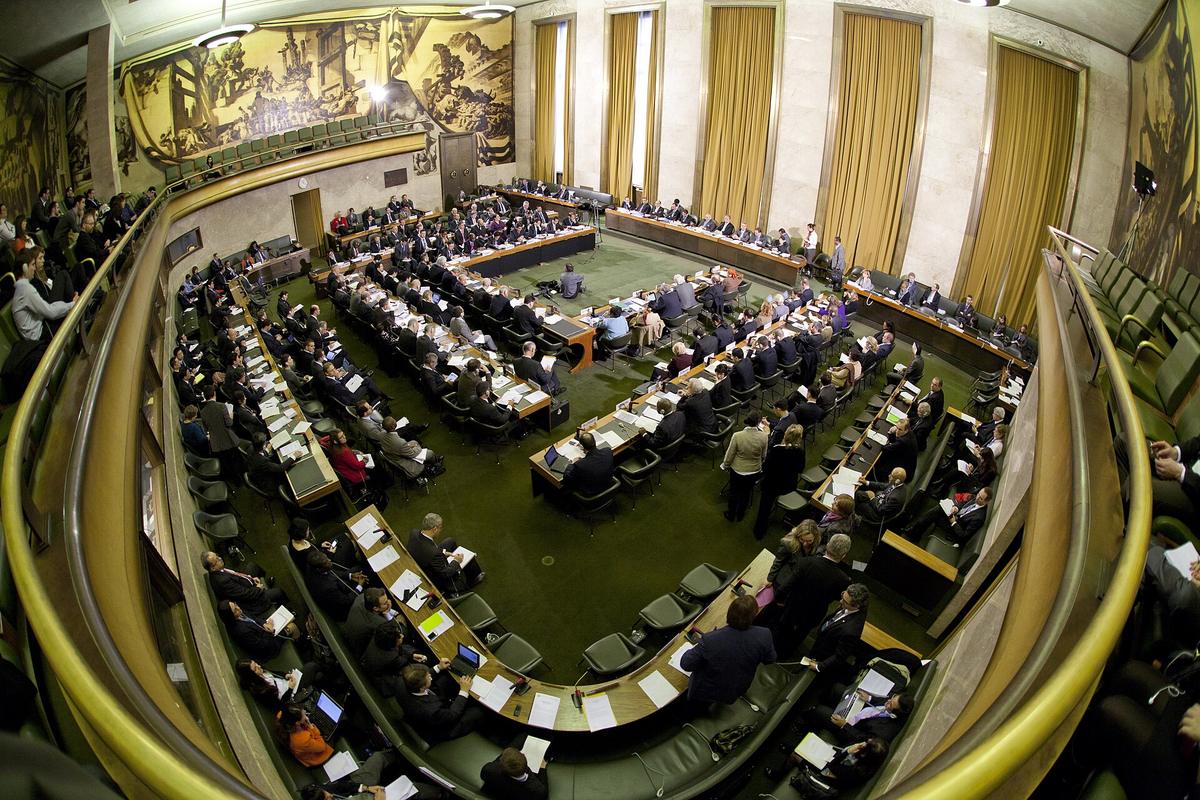
A moderated caucus is a focused debate on a specific subtopic. A participant motions for a moderated caucus on, for example, 'the humanitarian situation in Eastern Congo' with a speaking time of 45 seconds. If the motion passes, the chair calls on those who raise their placards. They speak one at a time until the time expires. This is where participants build arguments, challenge each other, and show the dais they can think on their feet. A student who cannot perform in moderated caucus cannot win an award at HMUN.
Unmoderated Caucus
An unmoderated caucus is a break in formal debate. Participants leave their seats, walk around the room, and negotiate directly. This is where blocs form. A bloc is an ad hoc coalition of delegations that agrees to write a draft resolution together. The fundamental political unit of a GA committee at HMUN is the bloc. A student without a bloc has no resolution and no path to an award. Unmoderated caucus time is limited, so use it efficiently. The share of total committee time devoted to unmoderated caucus is substantial, which favours informal negotiators over formal speakers.
Speakers List and Draft Resolutions
The speakers list is the default mode of debate. Participants speak for a set time on the general agenda. It is slower than moderated caucus and less common at HMUN, because most debate time is spent in moderated caucus. Resolutions are authored by blocs and introduced as documents, not built incrementally on the floor. A draft resolution contains preambulatory and operative clauses in proper UN format. The bloc submits it to the dais, and if approved, the committee debates and votes on it. HMUN committees pass one or two resolutions per session, depending on the committee type.
Committee Types
HMUN offers General Assembly committees, specialised agencies, and crisis committees. In a GA committee, participants represent member states and produce resolutions. In a specialised agency, the committee simulates bodies like the Security Council with binding resolutions. In a crisis committee, participants represent individuals rather than states and respond to real time fictional scenarios via directives. Crisis committees have a faster pace and different output: directives, not resolutions. The dais controls the crisis updates and the pace of the simulation. Students who prefer formal debate should choose a GA committee. Students who thrive on fast negotiation and roleplay should choose crisis.
HMUN Awards Culture: Tiers, Transparency, and What Actually Wins
HMUN has a competitive awards culture. Say this plainly: the conference is not a pedagogical exercise where everyone learns equally. Awards matter to the students who attend, and the award tiers are Best Delegate, Outstanding Delegate, Honourable Mention, and sometimes Verbal Commendation. These labels are stable across conferences, but how they are awarded at HMUN is specific.
The published criteria claim to weight position papers, speaking quality, and resolution contribution equally. In practice, the actual award drivers are dais visibility and bloc leadership. A student who writes an excellent position paper but never speaks in moderated caucus will not win. A student who leads a bloc, speaks often, and makes sure the dais knows their name will win, even if their position paper is average. This gap between published criteria and actual outcomes exists because assessing 100 participants objectively over a weekend is hard. The dais has limited time and attention. They remember the students who shaped the committee, not the ones who wrote a good paper and then sat silently.
The participant to staff ratio at HMUN affects this. A lower ratio means more individual attention from the dais. The solution for a student who wants an award is to be visible, useful, and essential to their bloc. The solution for a faculty advisor who wants a delegation to win is to train students on coalition building, not just research and writing.
Harvard MUN Conference Boston: What to Expect on the Ground
HMUN takes place in Boston, hosted at the Boston Park Plaza and surrounding hotels. The conference runs for four days. Attendees wear Western business formal attire during committee sessions. This norm is universal and enforced. Faculty advisors are chaperones, budget holders, and sometimes coaches. The faculty advisor manages the delegation registration, pays the fees, and accompanies students to sessions. At HMUN, the advisor is not a participant in committee but is responsible for student welfare outside committee hours.
Language and the Participant Pool
The working language is English. All committee sessions, study guides, and resolutions are in English. A student who is not fluent in English will struggle to participate effectively, especially in moderated caucus where speaking time is short and the pace is fast. HMUN markets itself as an international conference, but it provides no language support. The participant pool is heavily weighted toward private international schools and wealthy urban schools. This structural gap affects negotiation dynamics: students from well resourced programmes tend to have more training and experience, which can intimidate first timers from smaller programmes.
Costs
The cost band for HMUN is premium. Registration fees, travel to Boston, hotel accommodation, and meals add up. A delegation from outside the United States faces additional costs for visas and international flights. Evaluate whether the investment matches your programme's goals before you apply.
Who Should Attend HMUN and Who Should Skip
HMUN suits the student who can think fast, negotiate hard, and perform under pressure. It suits the faculty advisor who wants to take a competitive team to a flagship conference run by a top university. It suits the experienced participant chasing a gavel who needs to understand how awards are really decided and what separates a strong position paper from a forgettable one.
Skip HMUN if your delegation is new to MUN and has not trained on Harvard procedure. A first time team that walks into a 200 person GA committee without knowing how to motion for a moderated caucus will be overwhelmed. Skip HMUN if your budget is tight. The premium cost band means a delegation of eight can spend thousands of dollars on registration, travel, and accommodation, and there are mid range conferences that offer a better return on investment for a developing programme. Skip HMUN if your goal is to learn about actual United Nations operations or international law. MUN is a competitive simulation that teaches parliamentary tactics, coalition politics, and performance. It is not a class on diplomacy. Read academic international relations sources for that.
Download the HMUN study guide for the committee your strongest student will attend. Read the dais written background guide. Identify the subtopics that match your student's research strengths. Then train that student on moderated caucus. Have them practice giving a 45 second speech on a specific subtopic, then answering a point of information. If they cannot do that comfortably before the conference, they will not do it well in a room of 100 strangers in Boston.
Full specification
| Individual delegates or school delegations | School delegations | manufacturer |
|---|---|---|
| Run by | Harvard University | manufacturer |
| Where | Boston, United States | manufacturer |
| Working language | English | manufacturer |
| Who it is for | Secondary school | manufacturer |
| Rules of procedure | Harvard-style parliamentary procedure | manufacturer |
Figures labelled manufacturer are the maker's own claim and are measured by them. Owner reported figures are aggregated from owners and are the ones worth planning around.
Frequently Asked Questions About HMUN
What is the difference between HMUN and THIMUN procedure?
The key difference is the moderated caucus. Harvard procedure uses moderated caucus as a motion driven mode of debate. THIMUN procedure has no moderated caucus; debate runs through a formal speakers list and lobbying sessions. If your committee can motion for a moderated caucus, it is Harvard style. HMUN uses Harvard procedure. THIMUN, held in The Hague, uses THIMUN procedure.
Does HMUN require a position paper?
Yes. Every participant must submit a position paper before the conference. The paper must address each agenda item, demonstrate research, and follow the standard format. A participant who does not submit a position paper, submits one late, or submits a plagiarised paper is not eligible for awards.
How are HMUN awards decided?
The dais evaluates participants on position papers, speaking quality, and resolution contribution. In practice, dais visibility and bloc leadership are the strongest predictors of awards. A participant who leads a bloc and speaks often in moderated caucus has a much better chance than a quiet participant with a strong position paper.
Can an individual student register for HMUN?
No. HMUN admits school delegations only. Individual students cannot register. A student who wants to attend must join or start a school MUN club and register as part of a school delegation with a faculty advisor.
What is the failure mode to watch for at HMUN?
The invisible participant is the most common failure. A student who attends every session but never speaks, submits no written work, and does not join a bloc will be forgotten by the dais. This is caused by intimidation, under preparation, or a committee that is too large for natural participation. Prepare your students to speak on the first day, even if only to introduce themselves in moderated caucus.
Read next
-
 MUN Conference Safety: Safeguarding, Travel, and Supervision Responsibilities
A practical guide to safeguarding, travel, and supervision responsibilities for schools and universities sending delegations to MUN conferences abroad.
MUN Conference Safety: Safeguarding, Travel, and Supervision Responsibilities
A practical guide to safeguarding, travel, and supervision responsibilities for schools and universities sending delegations to MUN conferences abroad.
-
 How to Identify MUN Rules of Procedure: THIMUN vs Harvard-Style
A side-by-side guide to identifying whether a conference runs THIMUN or Harvard-style procedure, with a diagnostic question any delegate can apply.
How to Identify MUN Rules of Procedure: THIMUN vs Harvard-Style
A side-by-side guide to identifying whether a conference runs THIMUN or Harvard-style procedure, with a diagnostic question any delegate can apply.
-
 THIMUN The Hague
How THIMUN The Hague works: the definitive THIMUN procedure conference with delegation-only registration and consensus-driven resolution-building.
THIMUN The Hague
How THIMUN The Hague works: the definitive THIMUN procedure conference with delegation-only registration and consensus-driven resolution-building.
-
 London International Model United Nations
LIMUN accepts individual delegates readily, which changes everything for applicants without a university MUN society. How solo registration shapes the conference.
London International Model United Nations
LIMUN accepts individual delegates readily, which changes everything for applicants without a university MUN society. How solo registration shapes the conference.
-
 Berlin Model United Nations
BERMUN is a THIMUN-affiliated school-level conference in Berlin where procedure is driven by formal speakers' lists and lobbying, not moderated caucus.
Berlin Model United Nations
BERMUN is a THIMUN-affiliated school-level conference in Berlin where procedure is driven by formal speakers' lists and lobbying, not moderated caucus.
-
 National Model United Nations
What NMUN's sessions at UN Headquarters in New York actually mean for a delegate—and what they do not. The university-level pedagogical conference explained.
National Model United Nations
What NMUN's sessions at UN Headquarters in New York actually mean for a delegate—and what they do not. The university-level pedagogical conference explained.
-
 WorldMUN
's rotating host city makes it the most internationally mixed university conference and the most expensive to attend. What the rotation means for delegates.
WorldMUN
WorldMUN's rotating host city makes it the most internationally mixed university conference and the most expensive to attend. What the rotation means for delegates.
-
 Oxford International Model United Nations
OxIMUN and LIMUN are cross-shopped constantly. The practical differences in registration, committee size, and Oxford vs. London logistics compared.
Oxford International Model United Nations
OxIMUN and LIMUN are cross-shopped constantly. The practical differences in registration, committee size, and Oxford vs. London logistics compared.
-
 THIMUN Procedure vs Harvard Parliamentary Procedure: What a Delegate Does Differently
A delegate-facing comparison of THIMUN and Harvard parliamentary procedure, covering speaking, document-building, and coalition-forming differences.
THIMUN Procedure vs Harvard Parliamentary Procedure: What a Delegate Does Differently
A delegate-facing comparison of THIMUN and Harvard parliamentary procedure, covering speaking, document-building, and coalition-forming differences.