How Voting Procedure Works in Model UN: Majorities, Roll Call Votes, and Abstentions
How MUN voting procedure works, including simple and two-thirds majorities, roll call votes, abstentions, and how voting differs under THIMUN consensus rules.
How Voting Procedure Works in Model UN: Majorities, Roll Call Votes, and Abstentions
The chair calls for a vote. Placards rise across the room, but two delegates drop theirs during the count. The tally is twenty-three in favour, twelve against, two abstaining. The chair announces the motion passes. The delegate from France objects: twenty-three is not two-thirds of thirty-seven. The chair explains that abstentions are excluded from the total, so the denominator is thirty-five, and twenty-three is a simple majority. That moment, when a delegate gets the wrong number from the right arithmetic, is where MUN voting procedure breaks for newcomers. Understanding which majority threshold applies, what counts toward the total, and when you may abstain is the difference between winning a vote and losing one you thought you had won.

.jpg)
Simple Majority Vs Two-Thirds Majority MUN: Which Vote Uses Which Threshold
Procedural Motions and the Simple Majority
Procedural votes, motions to set speaking time, to open a caucus, to adjourn, require a simple majority of delegates present and voting. That means more than half of the votes cast, with abstentions excluded from the count. If thirty delegates are in the room and twenty-eight vote, fourteen is the majority threshold. If only twenty-six vote, thirteen is the threshold. The number of delegates present matters only for quorum, not for the majority calculation.
Substantive Votes and the Two-Thirds Bar
Substantive votes, on draft resolutions, amendments, and the closure of debate, require a two-thirds majority in most committees under Harvard and NMUN procedure. Harvard Model UN 2024 rules set the closure of debate and suspension of rules at two-thirds. NMUN 2024 rules set closure of debate at two-thirds. The real UN Charter Article 18 also uses two-thirds for important questions in the General Assembly, which is the origin of the rule.
Two-thirds means at least two out of every three votes cast. If thirty delegates vote, the threshold is twenty. If a delegate abstains, that vote does not count toward the denominator, so the same thirty delegates with one abstention require twenty of the twenty-nine votes cast. That is why abstentions can change the outcome: they reduce the total needed for a two-thirds majority.
When Simple Majority Applies to Substantive Votes
THIMUN procedure uses a simple majority for substantive votes on resolutions and amendments. THIMUN Rules of Procedure 2023 set the threshold at 50 percent plus one of members present and voting. That is the same bar as a procedural motion at any other conference. The consequence is that resolutions pass more easily in THIMUN committees, which is consistent with the system's goal of consensus adoption rather than competitive voting.
What the Security Council Changes
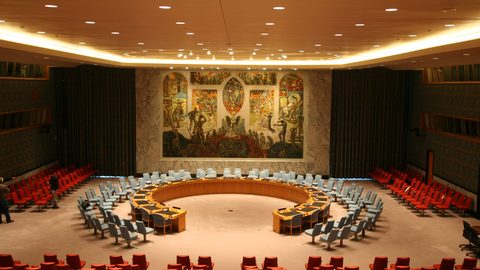
Security Council simulations in Harvard-style and NMUN procedure retain the veto power of the five permanent members. Nine affirmative votes are required, and any P5 member may veto a substantive resolution by voting no. The P5 veto is not simulated in THIMUN Security Council committees under the 2023 rules. The procedural-substantive distinction also shifts in the Council: determining whether a matter is procedural or substantive can itself be decided by a simple majority, but a P5 member may veto that determination in some conference rules.
Roll Call Vote MUN: How It Works and When to Request One
A roll call vote replaces the placard vote. Instead of raising a placard for the chair to count, each delegation is called alphabetically by the chair and responds aloud with its position. The options are the same as in a placard vote, yes, no, or abstain, with one additional option in most systems: pass. A delegate who passes on the first call must vote yes or no on the second call; a pass cannot remain a pass. That rule prevents a delegation from avoiding a recorded position indefinitely.
The Calling Order and the Right to Explain
The chair begins with a delegation chosen at random, then proceeds alphabetically. Harvard Model UN 2024 rules and NMUN 2024 rules both specify alphabetical order starting from a random point. During a roll call vote, no delegate may enter or leave the room. The chamber doors are sealed. A point of order is permitted only to correct a procedural error in the voting process itself, not to debate the substance of the resolution.
The Present and Voting Option
Two procedural families handle this differently. Under Harvard and NMUN rules, a delegate may respond “present and voting” at the start of a roll call vote. That declaration bars the delegate from abstaining on any subsequent vote within the same voting procedure. The logic is that a delegate who declares present and voting is committing to take a substantive position on every question. The option exists only if the chair announces it at the beginning of the roll call.
If a delegation is instructed by its faculty advisor or head delegate to abstain from a particular vote, that delegation must not declare present and voting. The failure case is a delegate who, in the moment, declares present and voting and then faces a vote where their assigned country has no policy position. That delegate cannot abstain and must vote yes or no, potentially contradicting their own position paper.
Worked Example of a Roll Call Vote
Committee: Disarmament and International Security. Resolution A on nuclear non-proliferation. The chair announces a roll call vote. The chair selects Chile as the first delegation to be called. The alphabetical order runs Chile, China, Colombia, Costa Rica, Cuba, Denmark, Egypt, France, Germany, and so on.
- Chile: Yes.
- China: Yes.
- Colombia: Pass. (Second call: Yes.)
- Costa Rica: No.
- Cuba: Present and voting.
- Denmark: Yes.
- Egypt: No.
- France: No.
- Germany: Yes.
When the chair reaches the end of the list, the delegates who passed are called again. Colombia, having passed, must now vote yes or no. The chair announces the tally: fifteen yes, eight no, zero abstentions. One delegate declared present and voting. Two delegations are absent and not voting. The total votes cast is twenty-three. The threshold for a two-thirds majority is sixteen. The resolution fails, fifteen to eight.
The chair does not count the absent delegations or the present-and-voting delegate's pledge toward quorum.
| Motion Type | THIMUN (2023) | Harvard MUN (2024) | NMUN (2024) |
|---|---|---|---|
| Substantive Resolution | Simple majority of present and voting | Simple majority of present and voting | Simple majority of present and voting |
| Amendment | Simple majority of present and voting | Simple majority of present and voting | Simple majority of present and voting |
| Closure of Debate | Two-thirds majority of present and voting | Two-thirds majority of present and voting | Two-thirds majority of present and voting |
| Suspend Rules | Not standard procedure | Two-thirds majority of present and voting | Not standard procedure |
| Reconsider a Resolution | Not standard procedure | Two-thirds majority of present and voting | Not standard procedure |
| Division of the Question | Not standard procedure | Simple majority of present and voting | Simple majority of present and voting |
| Abstentions Counted in Denominator | No | No | No |
| Default Voting Method | Placard vote | Placard vote | Placard vote |
| Roll Call Vote Trigger | Request by any delegate; chair discretion | Motion and majority approval | Motion and majority approval |
| Veto in Security Council | Not simulated | P5 veto retained | P5 veto retained |
Abstention MUN Voting: When You Can and Cannot Abstain
The Core Rule on Abstentions
You may abstain on a substantive vote, a vote on a resolution or an amendment, under all three major procedural systems. The abstention does not count toward the majority calculation. The research is consistent across THIMUN, Harvard, and NMUN rules: abstentions are excluded from the total of votes cast.
Procedural motions are different. Never abstain on a procedural motion. The chair asks for yes and no votes only. The logic is that procedural motions govern the functioning of the committee, and a delegation must take a position on how the committee operates. Abstaining on a procedural motion is treated as a no vote in many conference rules, though the chair will record it as an abstention only if the conference rules explicitly allow it.
Consensus and Abstention in THIMUN Procedure
THIMUN procedure aims for consensus adoption. The chair asks if there are any objections to the draft resolution. If no delegate objects, the resolution is adopted by acclamation. No vote is taken. If a delegate objects, the chair conducts a roll call vote. In that vote, a delegate who supported the resolution during lobbying but is not fully committed may abstain without blocking the resolution. The THIMUN consensus procedure does not require unanimity; it requires an absence of formal objection. Abstention is the mechanism for registering mild disagreement without forcing a vote that would fail.
How Abstention Affects Bloc Strategy
A delegate who abstains on a partner's resolution signals ambivalence. That signal can weaken a bloc in future negotiations because the partner knows the abstaining delegation is not reliable. The failure case is a delegate who abstains on a resolution their bloc authored, thinking it shows independence, while the bloc interprets it as betrayal. The delegate ends the committee with no allies for the next vote. The instruction is: abstain only when your assigned country's policy genuinely has no position, not when you personally dislike the resolution.
Common Questions
What is the difference between a procedural vote and a substantive vote in MUN?
A procedural vote decides how the committee operates: setting speaking time, opening caucuses, suspending rules, adjourning. A substantive vote decides the content of what the committee produces: a resolution, an amendment, or the closure of debate. Procedural votes require a simple majority. Substantive votes require a simple majority in THIMUN and a two-thirds majority in Harvard and NMUN systems for most resolutions and for closure of debate.
Can a delegate abstain on a procedural motion?
No. Procedural motions govern the functioning of the committee, and a delegation must take a position. The chair will typically ask for yes and no votes only. Abstaining on a procedural motion is treated as a no vote in most conference rules.
How does a roll call vote differ from a placard vote?
In a placard vote, the chair counts raised placards and announces the result. No record of individual positions is kept. In a roll call vote, each delegation is called alphabetically and must state its position aloud. A record is kept. A roll call vote requires a motion and majority approval in Harvard and NMUN systems. In THIMUN, any delegate may request a roll call vote, and the chair grants it at their discretion.
What does 'present and voting' mean in a roll call vote?
A delegate who declares 'present and voting' at the start of a roll call vote commits to voting yes or no on every question within that voting procedure. They may not abstain. The option exists only if the chair announces it at the beginning of the roll call. It is used by delegates who want to signal strong engagement but must be avoided if the delegation has instructions to abstain on any upcoming vote.
Are abstentions counted when calculating a two-thirds majority?
No. Abstentions are excluded from the total of votes cast. The denominator for the majority calculation is the number of delegates who voted yes or no. If twenty delegates vote and two abstain, the total is eighteen. A two-thirds majority requires twelve of those eighteen, not thirteen of twenty.
Does the Security Council have different voting rules in MUN?
Yes. Security Council simulations in Harvard-style and NMUN procedure retain the veto power of the five permanent members. Nine affirmative votes are required for a substantive resolution, and any P5 member may veto it by voting no. THIMUN Security Council committees do not simulate the veto. The procedural-versus-substantive determination also differs in the Council, and a P5 member may veto that determination in some conference rules.
What happens if a delegate passes during a roll call vote?
The delegate is called again at the end of the alphabetical roll. On the second call, the delegate must vote yes or no. A pass cannot remain a pass. The rule prevents a delegation from avoiding a recorded position indefinitely.
Read next
-
 MUN Rules of Procedure Explained: THIMUN vs Harvard Style Debate
How THIMUN and Harvard-style procedure differ, and why knowing the distinction before you enter the committee room determines whether you can participate.
MUN Rules of Procedure Explained: THIMUN vs Harvard Style Debate
How THIMUN and Harvard-style procedure differ, and why knowing the distinction before you enter the committee room determines whether you can participate.
-
 THIMUN Procedure vs Harvard Parliamentary Procedure: What a Delegate Does Differently
A delegate-facing comparison of THIMUN and Harvard parliamentary procedure, covering speaking, document-building, and coalition-forming differences.
THIMUN Procedure vs Harvard Parliamentary Procedure: What a Delegate Does Differently
A delegate-facing comparison of THIMUN and Harvard parliamentary procedure, covering speaking, document-building, and coalition-forming differences.
-
 HMUN vs HNMUN: The Difference Between Harvard's Two MUN Conferences
HMUN is Harvard's high school MUN conference in Boston; HNMUN is its university-level counterpart. Applying to the wrong one wastes an application cycle.
HMUN vs HNMUN: The Difference Between Harvard's Two MUN Conferences
HMUN is Harvard's high school MUN conference in Boston; HNMUN is its university-level counterpart. Applying to the wrong one wastes an application cycle.
-
 LIMUN vs OxIMUN: Comparing the UK's Two Largest University MUN Conferences
LIMUN and OxIMUN are the UK's two largest university MUN conferences. The practical difference is the admission route for a delegate without a society.
LIMUN vs OxIMUN: Comparing the UK's Two Largest University MUN Conferences
LIMUN and OxIMUN are the UK's two largest university MUN conferences. The practical difference is the admission route for a delegate without a society.
-
 Best MUN Conferences for a First Conference, Ranked on Survivability
MUN conferences ranked on what makes them survivable for a first-time delegate—beginner committees, published rules, and realistic applications—not on prestige.
Best MUN Conferences for a First Conference, Ranked on Survivability
MUN conferences ranked on what makes them survivable for a first-time delegate—beginner committees, published rules, and realistic applications—not on prestige.